


The Navjote Ceremony
Understanding the Navjote Ceremony
The initiation of a Parsi child into the fold of the Zoroastrian religion is known as Navjote. The ceremony of the initiation consists of the investiture of the child with a sacred shirt called sudre and a sacred thread called kusti. A Zoroastrian may put on any dress they choose to, but they must put on the sacred shirt &the thread as the symbol and badge of their religion.


The Meaning of the Navjote
The word Navjote is made up of two words Nav (Avesta, nava; Sans. nava; Lat. novus) new and Zote (Avesta zaotar from zu, Sans hu to offer prayers) one who offers prayers. Hence, the word would mean a new initiate to offer Zoroastrian prayers. The ceremony is so named, because it is after its performance that a Zoroastrian child is said to be responsible for the duty of offering prayers and observing religious customs and rites as a Zoroastrian. The ceremony of Navjote among the Parsis, corresponds to that of 'Confirmation' among the Christians.
Seven is the age, at which it is enjoined to initiate a child. In case a child is not sufficiently intelligent to understand the ceremony and to know its responsibilities, and in the case of some other unavoidable causes, it is permitted, that the ceremony may be postponed to any age up to fifteen, at which age the investiture must take place. A Zoroastrian without the sacred shirt and thread after the age of fifteen is supposed to be out of the fold and likely to fall into evil paths. On the other hand, the parents are believed to have a share in the meritoriousness of the child's act, if by virtue of the religious and moral education imparted to it, it does a righteous act.

The Ceremony
Before the ceremony, the child is made to go through a sacred bath or a kind of purification, known as Nahan (Sans. snan i.e. a bath). After the bath, the child is taken to a room, where the parents, their relations and friends, and the officiating priest with one or more priests have assembled. The part of the child's body, which is to be covered with the sacred shirt by the officiating priest, carries a sheet of cloth which can be easily removed. The child is made to sit before the officiating priest.
The following things are placed in the room before the officiating priest:
- A new set of clothes for the child, including a new sacred shirt and thread.
-
A tray full of rice, which, at the end of the ceremony, is presented to the family priest. It is a remnant of the old system when a part of the payment to the priest was made in kind.
-
A tray full of flowers to be presented, at the end of the ceremony, to the assembled guests.
-
A lighted lamp, generally a lamp burning with clarified butter. There may be one or more candle lamps.
-
Fire burning on a censer with fragrant sandalwood and frankincense.
-
A tray, containing a mixture of rice, pomegranate grains, small slices of coconut, raisins, and almonds, to be sprinkled, later on, on the child as a symbol of prosperity.
The tray, containing the suit of clothes for the child, also contains some betel leaves, betel nuts, a few pieces of sugar candy, a few grains of rice, a garland of flowers, a metallic cup containing kanku or a kind of red powder and a few Rupees. All these things have nothing to do with the religious ceremony, but, being considered in India as emblems of good luck, are handed to the child, later on, by the officiating priest

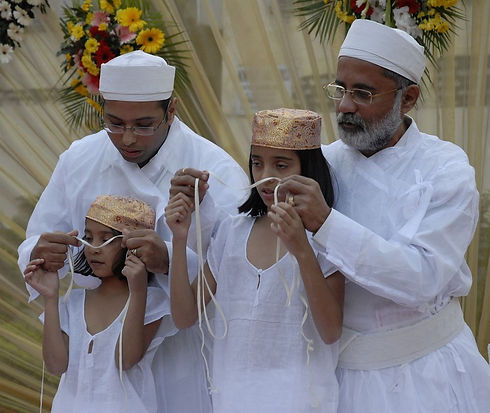

The Sudreh & Kusti
The sacred shirt called sudrah comes from the Avestan 'setehr paesehenghge' which means 'useful clothing'. It is made of white cambric, symbolic of innocence and purity, and, as such, is the symbol of the Zoroastrian religion. It is made up of two pieces of cloth sewn together on both sides, thus dividing the shirt into the front part and the back part, symbolizing the past (reminding a Zoroastrian of his duty to persons and institutions of the past ages) and the future (to remind us of our duty to the future - to our children and future generations).
The most important part of the shirt is the Giriban (lit. that which preserves the knot) which signifies loyalty to or faith in the religion. It is put up, in the form of a bag or a purse a little below the portion of the shirt which covers the part of the body below the throat. It indicates symbolically that one has to be industrious and has not only to fill one's bag with money but has to fill it up with righteousness
Sudre (the sacred shirt) indicates "advantageous path" and kusti indicates the proper direction of that path. Some derive the word from kosht i.e. waist, and say that it is so called because it is put on, on the waist.
The kusti is made of lamb's wool. It is considered to be the privilege of the women of the priestly class to weave the kusti and it is the privilege of priests to finally consecrate it before its ends are woven and finished.
The kusti, being prepared from the wool of a lamb, considered to be the emblem of innocence and purity, is held to be a badge reminding a Zoroastrian of the purity of life and action which he has always to observe.
The seventy-two threads, symbolize the seventy-two chapters of the Yasna, the liturgical prayers of the Parsis. The twenty-four threads which make up each of the three tassel-like laris or string-ends of the Kusti, symbolize the twenty-four sections, which were believed to make up the Visparad, another liturgical prayer. The six parts or strands, each of twelve threads, into which the seventy-two threads of the Kusti are divided at the time of weaving, are said to symbolize the six religious or ceremonial duties of a Zoroastrian. The twelve threads in each of the above twelve parts and strands symbolize the twelve months of the year. The six laris or tassel-like string ends, three at each end of the kusti, symbolize the six Gahambars or the six season festivals of a Zoroastrian year. The hollow of the thread symbolizes the space between the earth and the heaven, between this world and the next. The doubling or the twisting of the thread in the beginning symbolizes the connection between the present corporeal world and the future spiritual world. The weaving or the uniting together of all the threads into one, symbolizes Universal union.